
Executive Protection (EP) is a broad term describing a protection plan designed to safeguard a specific high-profile individual, such as a celebrity, corporate executive, entrepreneur, faith leader, or politician, from various threats. A comprehensive EP program includes a thorough risk assessment, meticulous logistics, protective intelligence, operational security, personal information security, metrics, a well-trained EP agent or team, and continuous program improvements. The program must also align with the culture and lifestyle of the person being protected. A successful EP program results in a safer, happier, and more productive protectee.
1. Risk Assessment

Before you start building an executive protection program, a security team needs to understand the risks facing its protectee. Risk can be calculated by researching and identifying known and likely threats, assessing the likelihood and severity of their materialization, and evaluating the VIP’s vulnerabilities.
The next step is to define the scope of protection, as resource limitations will constrain certain mitigation measures. Some measures may be deemed extreme or unwanted (ie, everyone needs alone time), while some risks cannot be avoided.
Every person and asset on the planet faces risk. If executive protection teams tried to eliminate all threats, protectees would never leave their home, and even then, risk avoidance is not absolute. Even at home, a VIP would still be at risk of severe weather, home invasion, fire, or even an unlikely but possible meteor strike.
The goal of an executive protection team is not to create a risk-free bubble but to help the protectee live a safer, more productive, and more confident life, which is accomplished through the following methods:
- Avoidance – You remove the chance of a risk occurring by avoiding an activity or action. An EP Team should not be reluctant to share its opinion on activities deemed to be too risky.
- Transfer – Your EP Team assumes responsibility for your personal safety, allowing you to focus on your family or business.
- Reduction – A professional EP Team will reduce risk by developing and implementing preventive mitigation measures.
- Acceptance – When a risk cannot be eliminated using any of the prior methods, your EP Team implements measures to make the endeavor as safe as possible.
2. Logistics/Security Advances

A security advance is a pre-event planning process that assesses the risk associated with a trip or activity. Advance work should be conducted for vacations, business trips, conferences, shopping trips, or even a dinner downtown.
When preparing their advance report, the EP Team should begin by reviewing their most recent intelligence report on their protectee for past and emerging threats.
Next, the EP Team should research potential risks associated with the site or venue, the travel route, the area surrounding the event, and any known individuals who may create risk due to their presence at the event or destination. Once the information is gathered, the team develops a primary plan, contingency plans, and an emergency response plan to address unexpected events.
With a clear understanding of potential threats and a solid framework in place, the EP team develops a detailed, coordinated approach that increases the likelihood that the trip or activity will be smooth and uneventful for their client.
3. Protective Intelligence

Without Protective Intelligence (PI), an EP Agent is just a bodyguard. The protectee goes about their life and business oblivious to risk. When a threat appears, the bodyguard reacts, hopefully preventing injury to the VIP’s well-being or reputation.
These days, the first thing a human threat will do when researching their target is search the internet for information. A PI Team monitors the web for negative content and sentiment regarding their client. They should also take proactive measures to remove personal information from the internet and replace it with disinformation, making it much more difficult to target the protectee.
PI is the data behind the risk mitigation process.
4. Operational Security

Human-generated threats come from three sources: insiders, outsiders, and outsiders with insider help (witting and unwitting); therefore, a professional EP Team will maintain a high level of operational security regarding its client’s personal information, lifestyle, travel information, and the EP Team’s operations.
In most situations, EP Teams work under non-disclosure agreements, not just as a formality, but as a key measure to protect the client’s personal information and ensure their privacy is fully respected.
5. Metrics

EP Teams should also document their activities so the program’s successes and failures can be evaluated.
6. EP Training
Effective executive protection is as much an art as it is a science. EP Agents must possess soft skills, including appearance, manners, morals, ethics, and social skills. EP Agents also need hard skills like defensive tactics, defensive driving, medical skills, and marksmanship.
The training doesn’t end there; EP Agents also need to be skilled in research, planning, logistics, teamwork, and emergency response.
While many people working in executive protection have law enforcement or military backgrounds, many successful and effective EP Agents have other experience and education that translates well in this personal, service-driven business.
7. EP Program Improvements
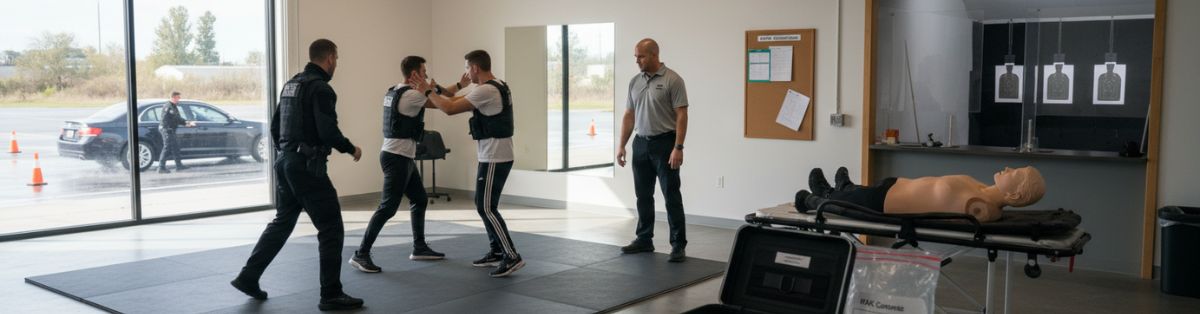
EP programs must continuously adapt to changing cultural, societal, and direct threats to the protectee. Additionally, a person’s personal and business life are constantly evolving; the EP Team must be flexible and make proactive changes to the protective program to ensure their client remains safe, happy, and productive.
8. Contact Serva PRS
If you face risks that you cannot mitigate on your own, please contact Serva PRS. We welcome the opportunity to discuss how a partnership can make your life safer, so you can focus on your mission.
Based in Nashville, Serva PRS also offers residential and neighborhood security teams, safe room construction, and digital privacy and anonymity services.
Stay safe at home: Read why every home needs a fortified safe room → Read the article